



When you run a heavy-duty warehouse storage rack supply business, I get asked one question more than any other-especially by clients looking to outfit facilities in seismic zones across the globe: What exactly is the seismic design code for heavy duty warehouse storage racks? It's not a trivial question. A warehouse isn't just a storage space; it's a dynamic hub that keeps supply chains moving, and a rack failure during an earthquake doesn't just mean lost inventory-it means safety hazards, operational shutdowns, and major financial losses. Over the past 12 years I've worked in this industry, I've helped hundreds of warehouses navigate this code maze, so let me break it down in plain terms that make sense, not just legalese.
First, I need to be clear: there isn't one universal seismic design code for these racks. Different countries and regions have their own standards, but most are rooted in a few global frameworks that guide how racks should be engineered to withstand ground motion. In the United States, the primary code comes from the Seismic Design Criteria set by the American Society of Civil Engineers (ASCE 7), which is adopted by most states through the International Building Code (IBC). For industrial facilities, ASCE 7-16 is the current version, and it has specific sections dedicated to non-structural components-like storage racks-that are often overlooked by general building codes. That's a key point I always emphasize to clients: racking is non-structural, so it's covered under different rules than the building itself, but those rules are just as strict.
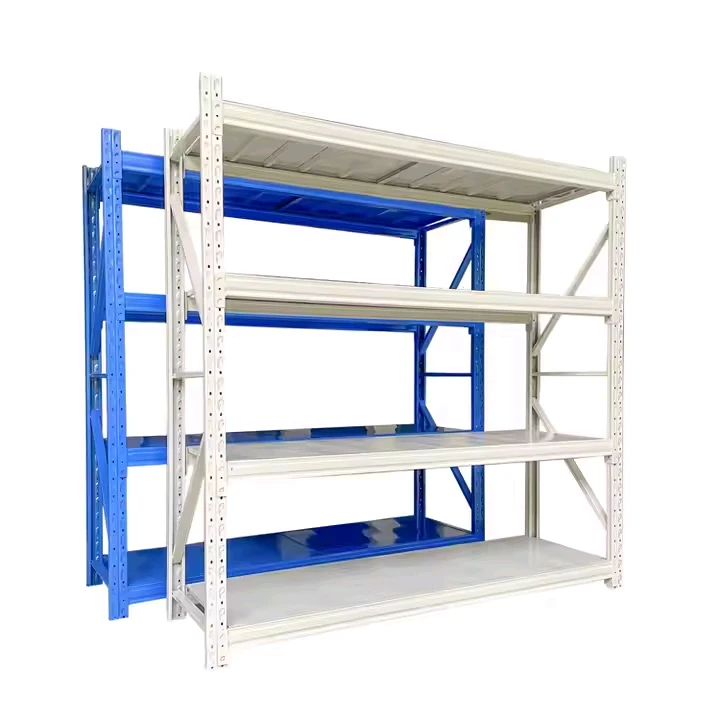

Let me walk through what ASCE 7-16 actually requires for heavy duty warehouse storage racks. The code starts by classifying the facility's occupancy category, which determines the level of seismic risk the rack system needs to handle. Warehouses that store general inventory are Category II, which means they need to resist seismic forces proportional to their weight and height. For racks, the code calculates a "seismic response coefficient" based on the site's seismic zone-places like California, Oregon, Washington, and parts of Alaska have much higher coefficients than states in the central U.S. or the Southeast. That's why a rack installed in Los Angeles can't be the same as one in Chicago; the ground motion is totally different.
Another critical part of the ASCE 7 standard is the requirement for rack components to be properly anchored. It's not enough to have heavy steel uprights sitting on the floor-they need to be bolted to the foundation in a way that prevents them from sliding or tipping during an earthquake. I've seen too many old warehouses where racks were just set on concrete footings with minimal bolts, and when a small tremor hits, the top of the rack can sway so much that pallets fall, or the whole structure collapses. For our Heavy Duty Steel Storage Racks, we engineer every anchorage point based on the site's specific seismic data, not a one-size-fits-all formula. That customization is non-negotiable for compliance.
Beyond the U.S., Europe has its own set of codes: EN 15512 is the standard for static storage systems, and it includes specific provisions for seismic performance. EN 1998 (Eurocode 8) covers seismic design for structures, and it applies to racking as a non-structural element there too. Clients shipping racks to countries like Germany, France, or Spain have to meet EN 15512, which has stricter requirements for rack stability under lateral forces. For example, the code mandates that racks be tested for their "seismic load displacement" to ensure they don't deform beyond safe limits when shaken. That's why when we work with international clients, we adjust our designs to align with both local and global standards, so their industrial warehouse storage racks are compliant no matter where they're installed.
One common mistake I see is warehouse owners using off-the-shelf racks without checking their seismic ratings. A lot of light-duty systems are designed for static storage, not dynamic seismic loads, and trying to cram heavy pallets on them in a high-risk zone is a recipe for disaster. That's why I always advise clients to work with suppliers who can provide third-party testing documentation for seismic performance. For example, our Warehouse Storage Pallet Rack line undergoes shake table testing to validate that it meets ASCE 7 and EN 15512 requirements, so our clients don't have to worry about failing inspections or facing costly retrofits later.
Let me also talk about the difference between light-duty and heavy-duty racks in seismic design. Light-duty systems, like shelving for small parts, have different dynamics than heavy-duty racks that store full pallets of goods. The code accounts for weight in its calculations because heavier loads exert more force during an earthquake. A 40-foot rack holding 2,000-pound pallets has a much higher center of gravity and lateral load than a small shelf holding a few pounds, so it needs more robust bracing, thicker steel, and stronger anchor bolts. That's why our Light Duty Pallet Racking is engineered for lower seismic forces, while our heavy-duty line is built to handle even the most demanding seismic zones.
Another important part of the code I want to highlight is regular inspection and maintenance. Seismic design isn't a one-and-done task-racks can degrade over time from forklift impacts, rust, or improper modifications, which can compromise their seismic performance. Most building codes require annual inspections of storage racks in high-seismic zones, and any damage must be repaired immediately. I tell all our clients to create a maintenance plan that checks for bent uprights, loose bolts, or broken bracing, because even a small issue can turn into a major problem during an earthquake. As a supplier, we offer seismic audits as part of our custom design services, which is another reason to work with a provider that understands the codes inside and out.
What about custom warehouse racking? Many warehouses have unique layouts-narrow aisles, high ceilings, or specialized inventory-that require a custom design, and seismic codes still apply. When we work on Custom warehouse racking projects, our engineers run detailed computer simulations to model how the rack will behave during an earthquake, adjusting the design to add extra bracing in weak points or reinforce areas with higher load concentrations. For example, if a client has a rack that runs along a wall in a high-seismic zone, we might add diagonal bracing to the ends to prevent the whole line from swaying. That level of detail is required by the codes, and it's what separates a compliant rack from one that's just structurally sound.
I've had clients ask me if there's a way to get around the strict seismic codes to save money. In the short term, maybe-cutting corners on anchors or using cheaper steel might lower the upfront cost, but the risk is not worth it. I've seen warehouses that skipped seismic requirements and had their racks collapse during a minor earthquake, resulting in millions of dollars in lost inventory, downtime, and liability claims. The codes were written based on decades of data from earthquake damage, so they're not arbitrary rules-they're proven to prevent failures and keep people safe. As a supplier, it's my responsibility to make sure every rack we sell meets or exceeds these codes, even if it means explaining to clients why a slightly more expensive design is the smart long-term investment.
Let me wrap this up with a quick recap of the key points about seismic design codes for heavy-duty warehouse storage racks: first, always check the local code in your region-ASCE 7 in the U.S., EN 15512 in Europe, and other standards in Asia, South America, and beyond. Second, make sure your rack is engineered for your facility's specific seismic zone, with proper anchorage and bracing. Third, choose a supplier that provides third-party testing and compliance documentation, especially for custom or heavy-duty systems. Fourth, schedule regular inspections and maintenance to keep your racks in compliance over time.
If you're outfitting a new warehouse, retrofitting an existing facility, or just have questions about seismic compliance for your current racks, don't guess at the code requirements. Reach out to our team to discuss your project-we can walk you through the local standards, help you design a rack system that's compliant, and make sure your facility is safe and resilient during any seismic event. Don't wait until it's too late; let's work together to build storage that meets the code and gives you peace of mind.