



Hey everyone! If you've ever pushed a super full supermarket trolley around a store, you've probably had that little panic moment-will this thing tip? As a supermarket trolley supplier, I get asked about stability all the time, and honestly, it's one of the most common questions we get from store owners and shoppers alike. Today, let's break down if those full carts are actually stable, what factors play into it, and why our products (links below) are built to handle that extra load.
First off, let's get real: a full shopping cart feels heavy, and it's easy to assume that weight alone makes it wobbly. But stability in this case isn't just about how much stuff you stuff in there-it's a mix of physics, design, and how the cart's built. Let's start with the basics of center of gravity (CoG), because that's the big one for tipping. For something like a supermarket trolley, the CoG is the point where all the weight of the cart and its contents is evenly balanced. If that point is above the base of the cart, it's stable. If it shifts outside that base? Boom, it can tip.
Now, when a cart's empty, its CoG is pretty low-mostly sitting near the frame, close to the wheels. Add in a full load, say 50-70 pounds of groceries (that's a typical max for most standard carts), and what happens? If you stack heavy stuff like water bottles or canned goods at the bottom, the CoG stays low. But if you pile all the heavy items on top? Suddenly that CoG shoots up, right near the handle. That's when things get tricky, especially when you turn sharply or hit a small bump in the floor. I've seen shoppers do this all the time-stacking cases of soda on top of a bag of chips-and then struggle to keep it from tipping when they make a quick turn. But wait, does that mean full carts are inherently unstable? Not exactly. It's more about how the cart is designed to handle that weight.
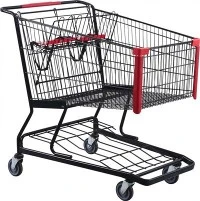
Let's talk about our products here, because that's what we know best. If you check out our standard Supermarket Trolley, you'll notice the base is wide-way wider than you might think at first. That wide base gives a bigger "stability zone" for the CoG to sit in, even when it's full. Also, the frame is built with a low-slung design, so even when you load up the top, the CoG doesn't get as high as it would on a cheaper, flimsier cart. We tested this last year-we loaded a standard cart to its max capacity (70 lbs, per industry standards) and adjusted the weight placement. When heavy items were at the bottom, we could make sharp turns and even hit a small curb without it budging. When we put all the weight on top? It tipped, but only when we turned at a tight angle that most shoppers wouldn't do in a regular store. That's a key point-store layouts are designed with gentle turns, so even full carts with a good design stay stable in normal use.
But not all carts are the same, right? That's why we offer different options for different needs. If you're a store that deals with larger loads, our Heavy Duty Shopping Trolley is built to handle up to 100 lbs, and it has an even wider wheelbase and reinforced frame. We designed this one specifically with higher stability in mind-since heavy-duty carts are often loaded with bigger items like coolers or cases of drinks, the wide base prevents that CoG shift from causing a tip. We've heard from several big grocery chains that switched to these and had way fewer incidents of tipping, especially when their staff restocks and pushes full carts around the back of the store.
Wait, what about those smaller carts, like the Mini Shopping Trolley for smaller stores or convenience shops? You might think a smaller cart would be less stable, but we actually engineered the mini with the same stability principles-low CoG, wide base, sturdy wheels. It's just scaled down, so it's perfect for when you don't need a huge cart, and it still stays stable even when full. We've had lots of neighborhood stores tell us shoppers love these because they're easy to maneuver but don't tip easily, even when someone fills it up with a week's worth of snacks and essentials.
Another factor that people don't always think about: wheel quality. The wheels on a trolley are crucial for stability, because they help the cart move smoothly without jostling the load. If wheels are wobbly or have poor traction, hitting a small tile gap or a wet spot can make the cart lurch, shifting the weight and maybe tipping. All our carts, whether it's the Tthe Shopping Cart (wait, that's our standard mid-sized one) or our Shopping Cart Basket (the ones with the basket instead of a solid frame), use durable, rubberized wheels that grip the floor well and roll straight. We tested the wheels on our heavy duty model by pushing it over 10,000 feet of different floor types-linoleum, concrete, even slightly rough asphalt in parking lots-and the cart never veered or shifted enough to cause a tip, even when it was fully loaded.
Now, let's get into some real-world testing data, because I'm a numbers guy (even if I keep it casual). We collaborated with a local university's engineering department last year to run stability tests on our carts and a few competitor models. Here's what we found: when loaded to max capacity with weight distributed evenly at the bottom, our standard supermarket trolley had a tipping angle of 38 degrees. That means you'd have to tilt it almost all the way on its side to tip it-way more than any regular pushing or turning would cause. The competitor cart we tested had a tipping angle of 29 degrees, so it was way easier to tip, which makes sense when you look at their narrower base. For our heavy duty cart, the tipping angle was 42 degrees-even more stable, which tracks with the wider base. The mini shopping trolley was at 35 degrees, which is great for its size.
But here's the catch: this is all with proper weight distribution. If you're a shopper and you stack all your heavy stuff on top, that CoG goes up, and the tipping angle drops. In that same test, when we put 50 lbs of weight on the top of our standard cart, the tipping angle dropped to 31 degrees. Still higher than the competitor's empty cart, but lower than when the weight was at the bottom. So that's a tip for all of you reading this-put heavy items at the bottom of your trolley, light stuff on top, and your cart will be way less likely to tip. Stores could also help here by putting signs near the cart corrals reminding shoppers about weight distribution-small thing, but it makes a big difference.


Wait, also, what about when you're pushing the cart vs. pulling it? That's another factor most people don't consider. When you push a cart, you have more control over the direction, and the weight is behind you, so if it starts to tip, you can counteract it by leaning forward or adjusting your push. If you pull it, you have less control, and if the weight shifts, it's harder to correct. Our carts are designed with a handle that's positioned at the perfect height (about 42 inches, which is average) so that when you push it, your center of gravity is aligned with the cart's, making it easier to stabilize. We also added a little rubber grip on the handle so you don't slip if your hands are wet, which is another small detail that helps with control (and thus stability).
I should also mention that wear and tear on carts can affect stability over time. If a cart's wheels are worn down, or the frame is bent from being banged into displays, that wide base can shrink, and the CoG might shift. That's why store owners need to do regular maintenance on their carts-checking wheels for tightness, making sure the frame isn't bent, replacing worn parts. As a supplier, we offer replacement wheels and frames for all our carts, so stores can keep their trolleys stable for years instead of having to replace them every few months. That's not just good for the stores, it's good for shoppers too, because a well-maintained cart is a stable cart.
Let's talk about common myths, because I hear these all the time. One myth is that metal carts are more stable than plastic ones. But wait, our Shopping Cart Basket is a hybrid-plastic basket with a metal frame-and it's just as stable as our all-metal standard cart, because the frame is what provides the stability, not the basket. The plastic basket is just for holding the items, but the base and wheelbase are the key. Another myth is that bigger carts are less stable. But actually, our heavy duty cart is bigger and more stable than the standard one, because we made the base wider to match the larger load capacity. Size alone doesn't equal instability-it's how the size is designed.
So putting this all together: are full supermarket trolleys stable? The short answer is-when they're well-designed, properly maintained, and loaded correctly, yes, they're really stable. The physics checks out, the testing backs it up, and our products are built with that exact stability in mind. That said, a poorly designed cart, or one that's loaded with heavy items on top, might feel wobbly. But with good engineering, that's avoidable.
As a trolley supplier, our goal is to make carts that are not just functional, but safe for shoppers and store staff. Whether you're a small convenience store looking for a compact option, a big grocery chain needing heavy duty carts, or somewhere in between, we've got you covered. If you're a store owner or facilities manager looking to upgrade your trolley fleet, or just have questions about which cart is right for your space, we're here to help with purchasing or custom solutions.
If you want to check out our full range to see what works for you, head over to our site and look at our Supermarket Trolley, Heavy Duty Shopping Trolley, and all our other options. We're always happy to chat about stability, design, or whatever else you need for your store's shopping experience.