



If you've ever walked down a grocery aisle, stood in line at a convenience store, or browsed the checkout area of a gas station, you've probably passed by more snack display racks than you realized. As a supplier of snack display racks, I get asked all the time: "What's the real difference between a wall-mounted one and a freestanding one? Which is better for my space?" It's not just a matter of personal preference-there are practical, space-saving, and sales-driven reasons to choose one over the other, and getting it right can make a huge impact on how well your snacks sell. Let's break this down, based on years of working with small convenience stores, big supermarkets, and everything in between.
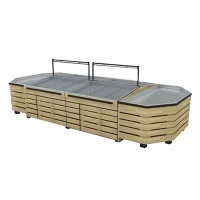
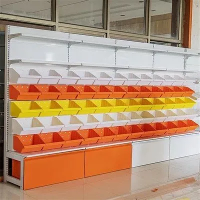
First, let's start with the basics to make sure we're on the same page. A wall-mounted snack display rack is exactly what it sounds like: it attaches directly to a wall, using brackets, screws, or mounting hardware, so it takes up zero floor space. A freestanding rack, on the other hand, sits on its own four legs or base, doesn't need to be attached to anything, and can be moved around as needed. At first glance, that seems simple, but the differences go way beyond just where they sit.
Let's talk about space, because that's the biggest factor most store owners care about. If you're in a small convenience store where every square foot counts, wall-mounted racks are a game-changer. They use vertical space that would otherwise go unused-think the empty wall above a checkout counter, or the area between two aisles. I had a client last year who ran a 500-square-foot neighborhood bodega; they were struggling to fit more grab-and-go snacks without blocking walkways. By adding a few Snack Display Rack that attached to their back wall, they added 30% more snack storage without taking up a single inch of floor space. Freestanding racks, by contrast, need at least a foot of clearance around them for people to walk, so they're better for stores with extra floor room. But here's a counterpoint: if you ever rearrange your store, freestanding racks can be moved. A wall-mounted one would need to be uninstalled and re-mounted, which is more work.
Next, stability and durability. When it comes to holding heavy snack bags-think big bags of chips, boxes of granola bars, or jars of nuts-you want something that's not going to tip over. Wall-mounted racks are attached directly to a stud in the wall, so they can hold a significant amount of weight without shifting. I've seen wall-mounted racks hold up to 50 pounds of snacks without any issues, even in high-traffic areas where people might bump into them. Freestanding racks, while sturdy, have a lower weight capacity because they're relying on their base to stay upright. If you overfill a freestanding rack, especially a tall one, there's a small risk of it tipping over-especially if a customer accidentally knocks into it. That's not just bad for the snacks; it's a safety hazard. A wall-mounted rack eliminates that risk entirely, which is why many of our restaurant and café clients prefer them. They don't have to worry about kids or distracted customers bumping into heavy displays.
Then there's visibility and customer flow. Let's be honest: the whole point of a snack display rack is to make people see the snacks and buy them. Wall-mounted racks are at eye level, right where customers are looking when they walk through a door or stand in line. They don't block other products, so customers can still see the aisles while glancing at the snacks. Freestanding racks, if placed in the middle of an aisle, can act as a barrier, forcing customers to either go around them or grab a quick snack. That's not always a bad thing-placing a freestanding Retail Snack Display Racks at the end of an aisle, for example, can create an impulse buy moment. But if you place it in a narrow aisle, it can make the space feel crowded and drive customers away. Wall-mounted racks, because they're on the wall, don't block flow at all. Our data shows that wall-mounted displays often have higher impulse sales because they're in the customer's direct line of sight without being intrusive.
Maintenance and cleaning are another big one, especially for busy store owners. Wall-mounted racks are easy to clean-you just need to wipe down the shelves, and since they're off the floor, you don't have to get under them. That's a huge time-saver for small stores where staff is already stretched thin. Freestanding racks, on the other hand, have legs and bases that can collect dust, crumbs, and even spilled soda underneath. Cleaning under them requires moving the rack, which can be a hassle if it's heavy and full of snacks. I always tell clients to think about how much time they spend on cleaning-if it's a lot, a wall-mounted rack might be the better pick. Though, to be fair, there are cleaning-friendly freestanding models, like those with open bases that don't trap crumbs. For example, a Countertop Snack Display Rack (a smaller freestanding option that sits on a counter) is super easy to wipe down, since it's not touching the floor at all.
Customization options also differ between the two. Wall-mounted racks often have fixed shelf heights, or at least limited adjustability, because they're attached to the wall. You can't move the shelves up or down without drilling new holes. Freestanding racks, however, usually have adjustable shelves, so you can customize the space to fit different sizes of snacks-taller boxes of crackers on the top, smaller candy bars on the bottom. If you sell a mix of large and small snack items, a freestanding rack might give you more flexibility. Some wall-mounted racks do offer a bit of adjustability, but it's not as easy as just sliding a shelf up or down like you can with freestanding models. When we work with clients, we ask them to list the types of snacks they carry, and that's a big factor in which one we recommend.
Cost is another practical consideration. Generally, wall-mounted racks are a bit cheaper than freestanding ones, because they don't have the extra parts for legs and a stable base. But wait-don't forget installation. A wall-mounted rack requires tools and some basic DIY skills (or hiring a handyman, if you're not comfortable drilling into walls). Freestanding racks are ready to use right out of the box; you just take them out, put them together (if needed), and place them where you want. For someone who's not handy, a freestanding rack might save you money on installation. But if you have a good idea of where you want it and don't mind drilling, the lower upfront cost of a wall-mounted rack is a plus. I've had clients who tried to install a wall-mounted rack themselves and ended up with holes in the wall that they had to patch up, so it's worth keeping that in mind.
Let's also talk about specific use cases to make this more concrete. If you're a café with a small wall space next to the register, a wall-mounted rack is perfect-you don't want a freestanding rack taking up floor space where customers might set down their coffee. If you're a gas station with a long aisle that gets a lot of foot traffic, a freestanding rack at the end of the aisle can be great for impulse buys, because it forces drivers to stop and grab something on their way out. If you have a small checkout counter, a Snack Organizer Shelf that's wall-mounted will free up counter space for registers and payment terminals. If you're setting up a snack bar in an office break room, a freestanding rack that can be moved to different areas (like near the fridge or by the microwave) is more useful, since break rooms often get rearranged.


Another thing I hear a lot from clients is about security. In areas where theft is a concern, wall-mounted racks are harder to move, so you don't have to worry about someone rolling a freestanding rack full of snacks out the door. That's a big plus for stores in areas with higher foot traffic where shoplifting might be an issue. Freestanding racks are easier to conceal or move, which is a risk if you don't have staff watching the snack area. Of course, you can add locks to freestanding racks, but that adds to the cost. Wall-mounted racks, being fixed to the wall, are a more secure option for high-theft areas.
Wait, but what about weight limits again? Let's clarify that. A well-installed wall-mounted rack can hold a lot-like I said earlier, 50 pounds is standard, and some heavy-duty models can hold more. But if you're packing it full of large, heavy items like cases of water (though that's more of a beverage rack), a freestanding rack with a wide base might be better, because a wall-mounted rack's weight is only supported by the wall. It's not that wall-mounted racks can't hold heavy things, but you have to make sure they're mounted to a stud, not just drywall. We always recommend that our wall-mounted racks be installed into wall studs, because drywall alone isn't strong enough to hold heavy loads. For freestanding racks, the wide base distributes the weight evenly across the floor, so they're more stable for heavier items, as long as they're not overloaded on the top shelf.
Let's wrap this up with a quick guide to help you decide. Ask yourself these questions:
- How much floor space do I have? If it's limited, go wall-mounted. If you have extra space, freestanding works.
- What's the weight of the snacks I'll be displaying? If they're heavy, wall-mounted (installed to a stud) or freestanding with a wide base.
- How often do I rearrange my store? If you move displays around a lot, freestanding is easier. If it's fixed, wall-mounted is fine.
- Do I need high visibility without blocking customer flow? Wall-mounted is better. If you want to create an impulse point in the aisle, freestanding at the end is great.
- How much time do I have for cleaning? Wall-mounted is easier to clean, since there's no space under the rack.
At the end of the day, both wall-mounted and freestanding snack display racks have their place, and the best choice depends on your specific store, your space, and your products. That's why as a supplier of snack display racks, we work with every client to understand their unique needs before recommending a product. Whether you need a wall-mounted rack for a tight corner, a freestanding rack for an aisle endcap, or a compact countertop option, we have solutions tailored to your business.
If you're ready to upgrade your snack display and boost your sales, we'd love to chat with you. We can walk you through the options, answer any questions you have about installation, weight limits, or customization, and help you find the perfect rack for your store. Don't hesitate to reach out to us today to discuss your snack display needs.