


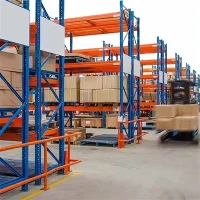


Hey there, if you've ever stood in a sprawling heavy duty warehouse and stared up at those towering metal structures holding everything from pallets of raw materials to bulk goods, you've probably wondered: how high can these things actually go? As someone who's been in the heavy duty warehouse racking shelving game for over a decade-helping warehouses of all sizes set up storage that works for them-I get this question all the time. It's not a one-size-fits-all answer, either. Let's break it down, no jargon, just real talk about what determines max height, how we make it safe, and what you need to know for your space.
First off, let's clear the air: when we talk about heavy duty racking, we're not talking about the little, desktop-style shelves in a home office. That's where you'd find something like a Light Duty Warehouse Rack, perfect for small parts or occasional storage, maxing out at maybe 10 feet if you're lucky, and only holding a few hundred pounds per shelf. Heavy duty? This is for moving thousands of pounds at a time, usually with forklifts, reach trucks, or other material handling gear, so the rules change fast. Industrial Warehouse Shelving for heavy use is built to hold that weight at scale, so their height limits are way higher-but they're not just stuck at a random number.
Let's start with the biggest factor: what kind of heavy duty racking system you're using. Because if you grab the wrong type, you're asking for trouble. The most common heavy duty option is selective pallet racking, which is what you see in most standard warehouses. Its max height? Typically 30 to 40 feet for reach trucks, and up to 45 feet if you're using very narrow-aisle or very high-rech machines. But wait-if you're storing long, awkward stuff like lumber, metal pipes, or furniture, you'd go with a Single Sided Cantilever Rack, right? Those don't have vertical posts in the way, so their height is a bit different-usually topping out around 30 feet, because long loads can be hard to stabilize that high without bending.
Wait, another big one: Industrial Shelving For Pallets, a close cousin to selective racking. Those are specifically designed for palletized goods, so their max height lines up with your warehouse's ceiling height and your forklift's lift capacity. Let's say your warehouse has a 50-foot clear ceiling-you could technically build racking up to 48 feet, leaving 2 feet of space for fire sprinklers, HVAC, and whatever else is up there. But that's only if your equipment can reach that high. A standard counterbalance forklift tops out at around 25 feet, so you're wasting that ceiling space if you build racking for 48 feet-you'd never use it. That's where getting the best racking system for warehouse matters a lot; picking something that matches your existing gear saves you money and frustration.


Now, let's talk about the science part, because it's not just "build as high as your ceiling will let you." There are two non-negotiable factors here: weight capacity and stability. Heavy duty racking isn't just metal bolted together; each upright frame has a rated capacity (usually in pounds per foot of height) and each beam has a weight limit. If you stack more weight than the beam can handle at height, the whole thing can collapse. It's not just a safety risk-it's a financial one, too. A single collapse can take out hundreds of thousands of dollars in goods and shut down your operations for weeks.
Stability is even more critical as you go higher. The heavier the load on the top shelves, the more likely the racking is to sway in high winds (if your warehouse is in a windy area) or shift during forklift operations. That's why we add bracing-horizontal and diagonal steel bars connecting the uprights-to keep the racking rigid. For racking over 30 feet, you might also need additional anchoring to the warehouse floor or even the walls, to prevent it from tipping over. We've had clients try to cut corners here, and it never ends well. A few years back, I worked with a small warehouse that built racking to the full 50 feet of their ceiling, skipped the extra bracing, and a forklift hit a top beam during a load drop, sending the whole section crashing down. They were out of commission for a month, lost $200k in goods, and had to replace all that racking anyway. Worth cutting the extra bracing for? Definitely not.
Then there's local building codes and fire safety rules. I can't stress this enough-every city, county, and even state has its own rules for heavy duty storage heights. Fire departments need access to the tops of racking for sprinkler maintenance and fire suppression, so you can't build racking all the way to the ceiling. Some areas mandate a 18-inch gap between the top of the rack and the ceiling, others 2 feet-check before you design anything. Also, seismic zones? If you're in California, Washington, or other earthquake-prone areas, your racking height is going to be lower than in a flat, stable part of the Midwest. Seismic codes require additional bracing in high-risk areas, which limits how high you can go without compromising safety.
What about different warehouse types, too? A cold storage warehouse is a whole different ballgame. The low temperatures make metal more brittle, so heavy duty racking there maxes out at 30 to 35 feet, even if the ceiling is higher. Cold storage equipment (reach trucks in freezers) can't lift as high as regular warehouse trucks, so again, you're not using that extra space. On the flip side, distribution centers that handle high-volume, fast-moving goods often use automated guided vehicles (AGVs) which can lift much higher-some up to 50 feet-so their racking can go that high if the space allows.
Wait, let's also address a common myth: higher is always better. Sure, using vertical space is smart for warehouses where floor space is tight, but if you're building racking that's too high for your equipment or your staff to safely access, you're wasting money. For example, if you have a small warehouse with a 30-foot ceiling and your forklift only lifts 20 feet, building racking to 28 feet is useless. You'll have 8 feet of space that's impossible to reach, so you're paying for metal you can't use. That's where custom solutions matter, right? We don't just sell one-size-fits-all heavy duty racking shelving-we work with each client to figure out their max height based on their ceiling, equipment, goods, and local rules.
Let's run through a quick real example to make this concrete. Last year, we worked with a mid-sized food distribution warehouse in Chicago. They had a 40-foot clear ceiling, used standard reach trucks that lift up to 35 feet, stored pallets of non-perishable goods (uniform weight, no weird loads), and were in a moderate seismic zone. We designed their selective pallet racking to go to 34 feet-leaving 6 feet for fire sprinklers, matching Chicago's code, and fitting perfectly with their forklift's lift capacity. They ended up using every inch of space without risking safety, and didn't have to pay for extra bracing they didn't need. That's the sweet spot.
Another example: a client that stores steel beams in Pittsburgh, a moderate seismic zone, with a 30-foot ceiling. They needed a rack that could hold long, heavy beams, so we went with the Single Sided Cantilever Rack. We set it at 28 feet-again, leaving 2 feet for ceiling clearance, the cantilever's maximum stable height for that load type, and their forklift's lift height of 29 feet. Perfect. If we'd gone higher, the beams would have started to sag, and the rack would have swayed too much.
Now, what happens if you go too high without checking all these boxes? Let's list the risks: structural failure (collapse), OSHA fines (they have strict rules about racking safety), damage to goods, injury or worse to staff, and downtime. OSHA actually has specific standards for heavy duty racking-they require regular inspections, load testing, and adherence to manufacturer-rated capacities. Cutting corners on height will almost always lead to a violation.
So, what's the actual maximum height of heavy duty warehouse racking shelving? It's not a number I can just spit out. For most standard warehouses, using common selective pallet racking and reach trucks, it's between 30 and 45 feet. If you have specialized equipment like high-reach forklifts or AGVs, you can push that up to 50 feet, but only if your ceiling allows, your load is within the beam's rated capacity, and you follow all local codes and seismic rules. For cantilever racks, it's usually under 30 feet, because of the long loads they handle. For cold storage, it's even lower-30 to 35 feet max.
Here's the thing: choosing the right height isn't just about fitting as much as possible. It's about building storage that's safe, efficient, and cost-effective. That's why we don't just sell you a rack and send you on your way-we help you walk through every step: measuring your ceiling, checking your equipment's lift capacity, figuring out what kind of goods you're storing, confirming local codes, and making sure the rack is stable enough for your space. If you're not sure what your max height should be, don't guess. A bad guess could cost you way more in the long run.
If you're planning to upgrade your warehouse storage or install new heavy duty racking shelving, don't waste time guessing. We've helped hundreds of warehouses find the perfect height and system for their needs-whether you need selective racking, cantilever, pallet-specific, or whatever works for your goods. We can walk you through the options, answer your questions, and make sure you get a solution that's safe, compliant, and uses your space well. Ready to chat through your project? Let's connect and figure this out together.