


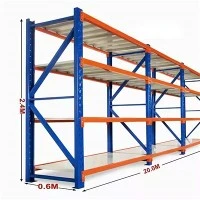

Hey there! As a supplier of Warehouse Storage Racking Metal Shelving, I often get asked how to pick the right depth for these shelving units. It's a crucial decision because the depth can significantly impact how well your warehouse operates. So, let's dive into this topic.
First things first, we need to understand why depth matters. The depth of warehouse storage racking metal shelving determines how much stuff you can store in each shelf, and it also affects how easily you can access the items. If the shelves are too deep, it might be a pain to reach the stuff at the back. On the other hand, if they're too shallow, you won't be able to fit as much in.


One of the most important factors to consider is the size of the items you're going to store. Think about the dimensions of the products, especially their length. For instance, if you're dealing with long items like lumber or pipes, you'll definitely need deeper shelves. In this case, a Double Sided Cantilever Rack or a Single Sided Cantilever Rack could be a great choice. These types of racks are designed to handle long and irregularly shaped items, and you can adjust the depth according to your specific needs.
If you're storing smaller items, such as boxes of inventory or small parts, you don't need super-deep shelves. You can still use warehouse industrial shelving with a more moderate depth. This way, you can easily access all the items on the shelf without having to dig through a bunch of stuff.
Another thing to think about is your storage system and how you want to organize your inventory. If you're using a First-In, First-Out (FIFO) system, where the oldest items are the first to be taken out, you might want to go for shallower shelves. This makes it easier to access the items at the front of the shelf, ensuring that the older inventory gets used first. However, if you're using a Last-In, First-Out (LIFO) system, deeper shelves could work well because you'll be accessing the items at the front, which are the most recently added.
The type of machinery or equipment you use in your warehouse also plays a role in determining the right depth. If you're using forklifts or pallet jacks to load and unload the shelving, you need to make sure there's enough space for the equipment to maneuver. Deeper shelves might require more space for the machinery to reach the back, so you need to balance the depth with the available space in your warehouse and the capabilities of your equipment.
Now, let's talk about the weight of the items you'll be storing. Heavy Duty Warehouse Shelving is designed to hold a lot of weight, but the depth can affect how well the shelves can distribute that weight. If you have very heavy items, you might want to limit the depth to ensure that the shelves can support the load evenly. Otherwise, you could risk the shelves bending or collapsing, which could be a huge safety hazard.
Cost is always a factor when making decisions for your warehouse. Deeper shelves generally require more materials, which means they can be more expensive. You need to weigh the cost of the shelving against the benefits of having more storage space. If you have a lot of inventory and need to maximize your storage capacity, investing in deeper shelves might be worth it. However, if you don't have a large amount of inventory or if you're on a tight budget, shallower shelves could be a more cost-effective option.
In addition to the above factors, the layout of your warehouse is also crucial. You need to consider how the shelving will fit into the overall space. If your warehouse has limited width, you might want to go for deeper shelves to make the most of the available space. However, if you have a wide warehouse, you could choose a combination of different depths to create a more efficient storage system.
Let's take a look at some real-world examples. Suppose you're running a hardware store warehouse. You have a mix of small items like screws and bolts, as well as larger items like power tools and lumber. For the small items, you could use warehouse industrial shelving with a depth of around 18 - 24 inches. This will allow you to easily access the items and keep them organized. For the lumber and long pipes, you'll need a Double Sided Cantilever Rack with a depth that can accommodate the length of the items, which could be anywhere from 36 inches to several feet.
Another scenario could be a food distribution warehouse. You'll likely be using a FIFO system, so you might want to choose shelves with a moderate depth, say 24 - 30 inches. This will make it easy to rotate the inventory and ensure that the older products are used first. You can also consider using Heavy Duty Warehouse Storage Rack to handle the weight of the food products.
In conclusion, choosing the right depth for warehouse storage racking metal shelving is a complex decision that depends on multiple factors. You need to consider the size and weight of the items, your storage system, the equipment you use, the layout of your warehouse, and your budget. By taking all these factors into account, you can select the shelving that will work best for your specific needs.
If you're still unsure about which depth is right for your warehouse, or if you have any other questions about our Warehouse Storage Racking Metal Shelving, don't hesitate to talk to us. We're here to help you make the best decision for your business and provide you with high-quality shelving solutions.