


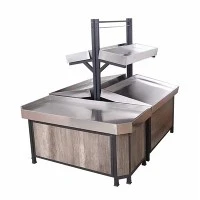


Hey there! As a supplier of Iron Vegetable Racks, I often get asked this really interesting question: What is the maximum number of vegetables an iron vegetable rack can hold? Well, let's dive right into it and find out!
First off, we've got to understand that there isn't a one - size - fits - all answer to this question. The capacity of an iron vegetable rack can vary widely depending on several factors.
Size and Design of the Rack
The physical dimensions of the rack play a huge role. A larger rack is obviously going to have more space to hold vegetables. We offer different sizes of Iron Vegetable Racks to meet various needs. Some are small, perfect for a home kitchen countertop, while others are large, industrial - grade ones designed for supermarkets.
For example, a small, single - tier iron vegetable rack with dimensions of about 12 inches by 18 inches might hold a handful of small to medium - sized vegetables like bell peppers, onions, or tomatoes. Maybe around 10 - 15 pieces at most.
On the other hand, a large supermarket - style rack like our Supermarket Metal Iron Fruit and Vegetables Shelving, which could be multiple tiers and have a footprint of several square feet, can hold hundreds of vegetables. Picture a rack that's 6 feet long, 3 feet wide, and has 4 tiers. Each tier can hold a significant amount. If we estimate that each square foot can hold about 5 - 10 medium - sized vegetables depending on how they're arranged, this large rack could potentially hold well over 300 vegetables.
The design of the rack also matters. Some racks have slanted shelves, which is great for better visibility of the vegetables but might reduce the actual loading capacity a bit because the space isn't used as efficiently as in a flat - shelved rack. Other racks come with dividers, which are useful for separating different types of vegetables but again might limit the overall number that can be stored if the dividers are too close together.
Vegetable Size and Shape
The size and shape of the vegetables themselves are crucial factors. If you're dealing with tiny baby carrots, you can fit a whole bunch of them in a small space. These can be packed tightly together, and a small rack could hold dozens.
Large, irregularly - shaped vegetables like pumpkins or watermelons, however, take up a ton of space. A single large pumpkin might take up as much room as 10 - 15 regular onions. So, if you're filling a rack with these large veggies, the number you can store will be much lower compared to using smaller, more compact vegetables.
Let's say you have a rack designed for fruits and vegetables with a flat surface area of 2 square feet. If you're storing strawberries, you could probably fit around 50 - 60 of them, considering their small size and ability to be packed closely. But if you try to put large cabbages in the same space, you might only be able to fit 2 - 3.
Stacking and Arrangement
How you stack and arrange the vegetables on the rack also affects the capacity. If you haphazardly throw vegetables on the rack without any thought, you're not going to make the most of the available space.
For instance, carrots can be arranged in rows vertically, making it possible to fit more of them in a given area compared to if they were just dumped randomly. On the other hand, some vegetables like tomatoes need a bit of space between them to prevent bruising. So, even though they're relatively small, you can't stack them as tightly as something like potatoes.
Our Iron Fruit and Vegetable Rack is designed in a way that allows for smart stacking and arrangement. The sturdy iron construction can support different stacking methods, whether you want to stack vegetables in a pyramid - like formation or arrange them in neat rows.
Let's consider a practical example. We had a customer who owned a small farmers' market stall. They bought our Iron Vegetable Display Stand. It was a multi - tiered stand with flat shelves. At first, they just dumped the vegetables on the shelves, and the stand didn't look very appealing and couldn't hold as many vegetables as it could potentially.
We gave them some tips on how to arrange the vegetables. They started by placing the larger vegetables like zucchinis at the bottom and then carefully stacked smaller ones like radishes on top. By using this method, they were able to increase the number of vegetables they could display on the stand by almost 30%.
Weight Capacity
Another important factor is the weight capacity of the iron vegetable rack. Even if there's enough physical space on the rack, it won't be able to hold an unlimited amount of vegetables if it's not strong enough to support the weight.
Our iron racks are built to be sturdy. We use high - quality iron materials that can withstand a good amount of weight. For a home - use iron vegetable rack, it might have a weight capacity of around 50 - 100 pounds. This means you can fill it with a reasonable amount of vegetables without worrying about it collapsing.
The heavy - duty racks we supply for supermarkets can have a weight capacity of several hundred pounds. This allows them to be fully loaded with a large quantity of vegetables, whether it's a week's supply for a medium - sized supermarket or just for a big display.


Conclusion
So, as you can see, determining the maximum number of vegetables an iron vegetable rack can hold is a complex matter. It depends on the size and design of the rack, the size and shape of the vegetables, how you stack and arrange them, and the weight capacity of the rack.
If you're in the market for an iron vegetable rack, whether it's for your home kitchen, a small store, or a large supermarket, we've got a range of options to meet your needs. Our racks are not only functional but also durable and stylish, making them a great addition to any space where you store or display vegetables.
If you're interested in learning more about our products, seeing different sizes and designs in person, or getting a quote for a bulk purchase, don't hesitate to reach out. We're here to help you make the best choice for your vegetable - storage needs.