


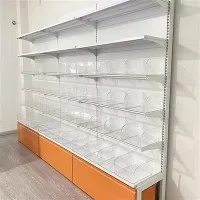

As a supplier of light duty warehouse racks, I often receive inquiries from customers about the installation space required for these racks. Understanding the necessary installation space is crucial for efficient warehouse layout and inventory management. In this blog post, I will delve into the factors that determine the installation space for light duty warehouse racks and offer some practical guidelines.
Factors Affecting the Installation Space
1. Rack Dimensions
The physical dimensions of the light duty warehouse racks themselves are the most obvious factor influencing the installation space. Light duty racks come in various sizes, and the length, width, and height of the racks will directly determine how much floor area and vertical space they occupy. For example, a standard light duty rack might have a width of 800mm, a length of 2000mm, and a height of 2000mm. When planning the installation, you need to ensure that there is enough clear space to accommodate these dimensions without any interference.
2. Aisle Width
Aisles are essential for accessing the stored items on the racks. The width of the aisles depends on the type of handling equipment used in the warehouse. If you are using manual handling equipment such as pallet jacks, a narrower aisle of about 1.2 - 1.5 meters may be sufficient. However, if you are using forklifts, the aisle width needs to be wider, typically around 2.5 - 3 meters to allow for safe maneuvering. These aisle widths need to be factored into the overall installation space calculation.
3. Storage Density Requirements
The storage density you aim to achieve in your warehouse also plays a significant role in determining the installation space. Higher storage density means more racks can be installed in a given area, but it may require a more compact layout and potentially narrower aisles. On the other hand, if you prioritize easy access to every item, you may need to sacrifice some storage density and have wider aisles and more space between the racks.
4. Safety Clearances
Safety clearances are necessary to ensure the safety of the warehouse workers and the integrity of the stored items. There should be a certain distance between the racks and the walls, columns, or other structures in the warehouse. Additionally, there should be enough clearance above the racks to prevent any interference with the sprinkler systems or other overhead equipment. A general rule of thumb is to leave at least 100 - 200mm of clearance between the racks and the surrounding structures.
Calculating the Installation Space
To calculate the installation space for light duty warehouse racks, you need to consider all the factors mentioned above. Here is a step-by-step guide:
- Determine the Rack Configuration: Decide on the number of racks you need based on your storage requirements. Consider the layout of the racks, such as whether they will be arranged in single rows, double rows, or multiple rows.
- Measure the Rack Dimensions: Measure the length, width, and height of the selected light duty rack. Multiply the number of racks by the rack dimensions to get the total floor area and vertical space occupied by the racks.
- Calculate the Aisle Width: Determine the appropriate aisle width based on the handling equipment you will use. Multiply the aisle width by the length of the aisle to get the total area occupied by the aisles.
- Add Safety Clearances: Add the required safety clearances to the total area calculated in steps 2 and 3.
Here is an example calculation:
Suppose you need to install 10 light duty racks with a width of 800mm, a length of 2000mm, and a height of 2000mm. You plan to arrange the racks in a single row with a 2-meter-wide aisle. The safety clearance between the racks and the walls is 100mm.
- Total floor area occupied by the racks: 10 racks x 0.8m (width) x 2m (length) = 16 square meters
- Area occupied by the aisle: 2m (width) x (2m x 10 racks) = 40 square meters
- Safety clearance: 0.1m (clearance on each side) x 2 (sides) x 2m (length of the racks) = 0.4 square meters
Total installation space required: 16 + 40 + 0.4 = 56.4 square meters
Choosing the Right Racking System
When considering the installation space for light duty warehouse racks, it is also important to choose the right racking system for your specific needs. There are several types of racking systems available, each with its own advantages and disadvantages in terms of space utilization, storage density, and accessibility.


- Selective Racking: This is the most common type of racking system, which offers easy access to every pallet or item stored on the racks. It is suitable for warehouses with a high turnover rate and a wide variety of products. However, it may not be the most space-efficient option as it requires relatively wide aisles.
- Drive-In Racking: This type of racking system allows forklifts to drive directly into the racks to access the stored items. It is ideal for warehouses with a large quantity of the same product and a low turnover rate. Drive-in racking can significantly increase the storage density but may limit the accessibility to the stored items.
- Push-Back Racking: Push-back racking is a high-density storage solution that uses a series of nested carts to store the pallets. It allows for easy access to the front pallets while still providing a relatively high storage density. This type of racking system is suitable for warehouses with a moderate turnover rate.
For more information on different types of racking systems, you can visit our website to explore our Heavy Duty Industrial Warehouse Rack, best racking system for warehouse, Industrial storage racking systems, Warehouse Storage Racking Systems, and Heavy Duty Warehouse Racking Shelving.
Conclusion
In conclusion, the installation space required for light duty warehouse racks depends on a variety of factors, including rack dimensions, aisle width, storage density requirements, and safety clearances. By carefully considering these factors and choosing the right racking system, you can optimize your warehouse space and improve the efficiency of your storage operations.
If you are interested in purchasing light duty warehouse racks or need more information on the installation space requirements, please feel free to contact us. Our team of experts will be happy to assist you in finding the best solution for your warehouse.